

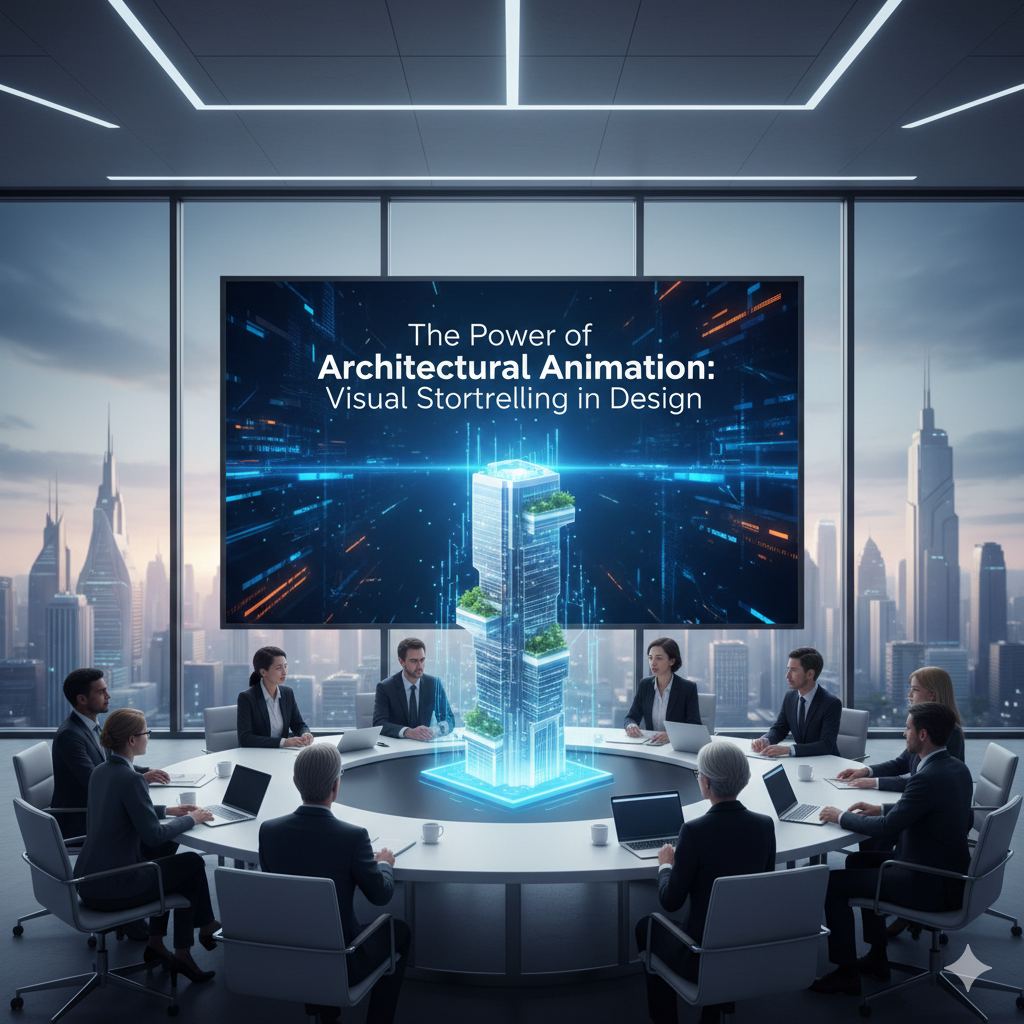

The ability to visualize architecture was greatly dependent on photorealistic imagery to capture the essence of a design, but this has been replaced by Architectural Animations. While photorealistic renderings are known for their ability to provide impressive detail and clarity, they are certainly not up to the task of demonstrating a space and its movements. These animations provide a compelling experience of an architecture that has revolutionized how projects are perceived and presented. The storytelling aspect of these animations has proved to be very efficient for a variety of projects, including residential, commercial, and even mixed-use properties. Thus, a viewer can experience tangibility through animations for an architectural space.
The Power of Architectural Animation
Digitalization has allowed professionals to present an architectural design in a space in the most creative ways. And, animations surely come in the top three in demonstrating a design ultra-realistically. From the following discussion, you can grasp the power of animations in the architectural realm:
Design Elaborateness
In animations, architectural design elements can be elaborately explored from any viewpoint. This means that any design element can be viewed to understand how it relates to the environment.
Spatial Flow Understanding
These animations allow a viewer to fully comprehend the spatial flow. This includes how spaces connect and interact as a whole. This allows a viewer to experience a transition between different rooms and the overall layout.
Contextual Representation
Animation provides context-driven presentations, which can efficiently highlight an architectural design’s purpose that truly resonates with a client’s expectations. Thus, aligning with the interests of potential buyers. Now, explore with us the realm of animations in the world of architecture with the help of its innovative types.
Types of Architectural Animations
An architectural project can be animated based on the following types.
Walkthrough Animations
Exactly as the name suggests, these animations allow a viewer to walk through a space. These animations provide an expanded view of the spatial layout as well as interior architectural design elements. Such animations can be used for both residential and commercial architectural design.
Flythrough Animations
These animations mostly provide an aerial perspective, especially for large developments. These animations are specifically utilized to understand a site and the surrounding environmental context.
Exploded Animations
To visually understand how an architectural design is created, these animations are used. It provides an exploded view and deconstructs architectural elements, thus visually demonstrating design aspects.
Time-Lapse Animations
This animation type provides a time-lapse visual depiction of how the environment changes over a long period of time. Thus, providing future insights about the environmental changes.
360 Degree Animations
These animations are specifically used to provide an interactive experience for an interior architectural design or an entire interior space. It allows a viewer to explore any design element by increasing engagement visually.
Emerging Digital Tools For Animations
The tools that make Architectural Animation Services efficient throughout the process are as follows.
- V-Ray
- SketchUp
- Maya
- Corona
- AutoCAD
- Revit
- Enscape
- Lumion
- Unreal Engine
What These Tools Offer?
Real-Time Rendering
With this feature, architects can develop a realistic design in just a matter of hours. It ensures that a design is created based on real-world scenarios. This ensures that a viewer can interact with a design by having a deeper connection.
Virtual Reality
This approach enables professionals to virtually create an entire space by including the desired architectural elements. Understanding design elements along with the spatial flow becomes relatively easier with this approach. Also, this technique has proved to be highly productive for projects with complex floor plans.
Artificial Intelligence
This technique, when integrated with the above mentioned tools, makes the animation process seamless. It does so by automating the whole animation process, thus making it more time-efficient. On top of that, it can also optimize key aspects involved in an animation, such as lighting or contextual environment.
Integral Steps For Compelling Animations
For an immersive animation to be created, it is important to follow certain steps. And, to ensure that these steps are completed efficiently, professional animators, such as SMA Archviz, need to be hired. They ensure that each step is thoroughly performed to acquire the desired outcomes. The most significant steps are as follows
Camera Setup
In an animation, positioning a camera can make a huge difference. It ensures that a viewer can naturally wander around the space or design.
Lighting
Lighting in animations helps to acquire the right mood. In other words, lighting will set the overall ambiance in an animation. Thus, to ensure that the right lighting is captured and the true design intent is depicted, the aforementioned tools make all of it possible.
Materials
Material and other details, such as textures and reflections makes an animation tangible. It gives an animation a certain level of depth and realism.
Transition
How an animation is transitioned matters a great deal. It makes sure that the flow of animation and the transition from space to space is natural.
End Note
Lastly, the architectural field is moving towards digitalization, and in this regard, one has to keep up with technological advancements in order to stay updated. To create animations for any level of architectural project, it is essential to acknowledge the technology discussed in this informative guide. Furthermore, what Architectural Animations encompass has been thoroughly mentioned in this article. So, read this guide to understand how immersive animations are created.