Walk onto any major construction site in Riyadh or petrochemical facility in Jubail, and you'll notice something quickly: safety isn't treated as an afterthought anymore. It's a core operational requirement, backed by regulation, insurance obligations, and increasingly, international client expectations. This shift is precisely why NEBOSH Courses have become a near-standard requirement across Saudi Arabia's highest-growth industries.
Vision 2030 has reshaped the Kingdom's economic landscape. Giga-projects like NEOM, the expansion of Saudi Aramco's downstream operations, and a continuous wave of infrastructure and manufacturing investment have created enormous demand for skilled labor — and an equally enormous responsibility to manage the risks that come with rapid industrial growth.
Regulatory bodies, including GOSI and the Ministry of Human Resources and Social Development, have responded by tightening workplace safety expectations. For organizations operating in the Kingdom, that means HSE teams need more than informal safety knowledge — they need internationally recognized proof of competency. This is where a NEBOSH Certificate becomes essential rather than optional.
Oil, Gas, and Petrochemicals:
Saudi Arabia's energy sector remains the backbone of its economy, and the risks involved — from process hazards to major accident potential — mean HSE professionals here are expected to hold specialized qualifications. NEBOSH PSM, specifically designed for process industries, has become particularly sought-after among engineers and safety officers in this sector.
Construction and Infrastructure:
With giga-projects spanning entire new cities, construction safety has never been under more scrutiny. NEBOSH IGC — the most broadly applicable of all NEBOSH Courses — is now a common requirement for site safety engineers and supervisors across major Saudi contractors.
Manufacturing and Power:
As Saudi Arabia diversifies away from pure oil dependency, manufacturing and power generation facilities are expanding rapidly, bringing their own occupational hazards and corresponding demand for certified safety personnel.
Marine, Logistics, and Healthcare:
Even sectors outside traditional heavy industry — port operations, logistics hubs, and healthcare facilities — increasingly list NEBOSH qualifications as preferred criteria for safety-focused hiring.
It's worth understanding that not all NEBOSH Courses carry equal weight for every role. Entry-level positions often accept a NEBOSH HSW award, while mid-level HSE roles typically require the NEBOSH IGC. Senior or specialist roles in high-hazard sectors increasingly expect NEBOSH PSM or the International Diploma. Before enrolling, it's worth reviewing actual job postings in your target sector to understand which qualification level Saudi employers are asking for.
The NEBOSH course requirements are refreshingly accessible compared to many academic qualifications. There's no mandatory prior degree for HSW, IGC, or PSM. What you do need is solid English reading and writing ability, since NEBOSH assessments are conducted entirely in English, along with reliable internet access and a suitable device for online learning and exams. Work experience isn't compulsory, though it becomes genuinely valuable once you move toward Diploma-level study, where practical workplace context helps you apply theoretical concepts.
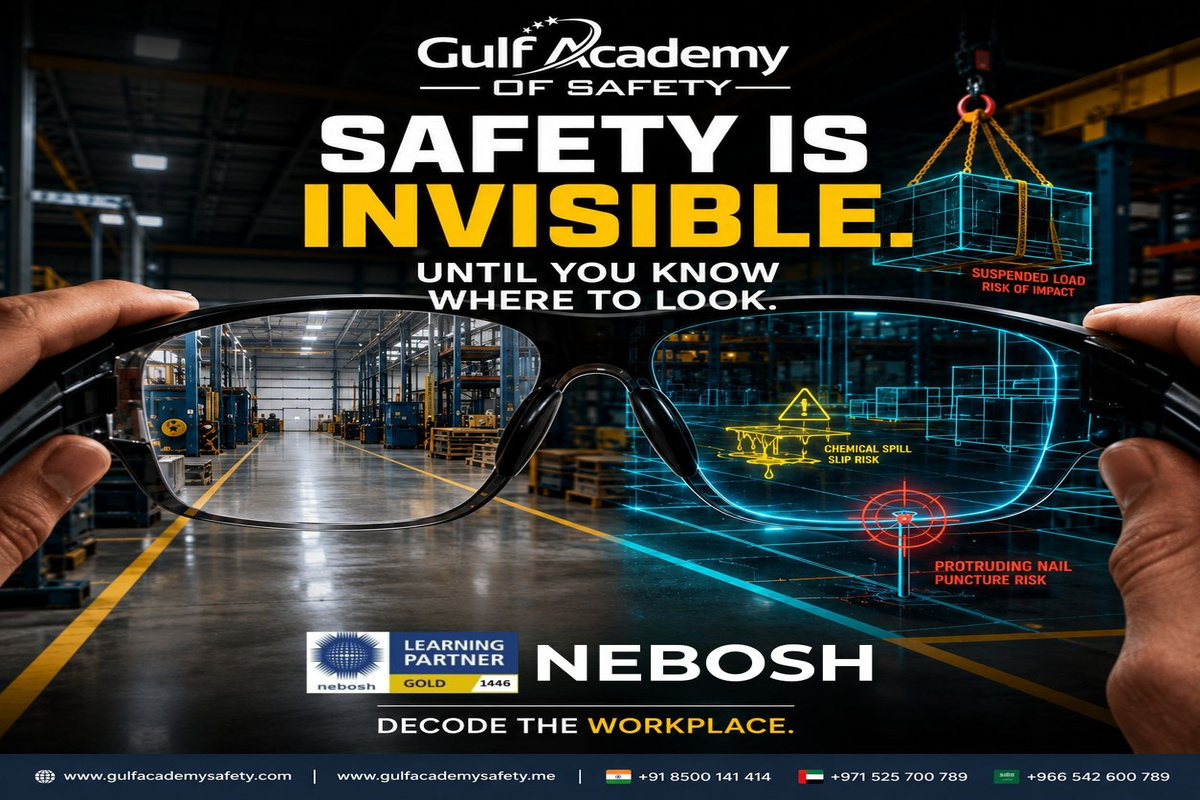
Given how much weight employers place on the credential, it's critical to train with a properly accredited provider. A NEBOSH Gold Learning Partner designation is NEBOSH's top-tier accreditation, awarded only to providers who meet strict quality assurance standards across materials, trainers, and exam pass rates. Providers like Gulf Academy Safety hold this status directly (accreditation ID: 1446), meaning their NEBOSH Training is delivered under NEBOSH's own oversight rather than through an unaccredited intermediary — an important distinction in a market where training quality varies significantly.
Professionals completing NEBOSH Courses in Saudi Arabia typically move into roles including HSE Officer, Site Safety Engineer, Safety Auditor, Risk Control Advisor, and — for those specializing in process safety — Process Safety Executive. Given the scale of investment across oil and gas, construction, and manufacturing, demand for these roles shows no sign of slowing.
As Saudi Arabia's industrial ambitions continue expanding, so will the expectation that safety professionals hold internationally recognized credentials. A NEBOSH Certificate isn't just a resume line anymore — it's increasingly the entry ticket to serious HSE careers across the Kingdom's highest-growth sectors.
Explore NEBOSH Courses suited to your industry and Contact Us to get started.

This post has been authored and published by one of our premium contributors, who are experts in their fields. They bring high-quality, well-researched content that adds significant value to our platform.










Home Guide provides trusted home improvement tips, DIY ideas, maintenance guides, and interior design inspiration to help you create a smarter, safer, and more beautiful home.