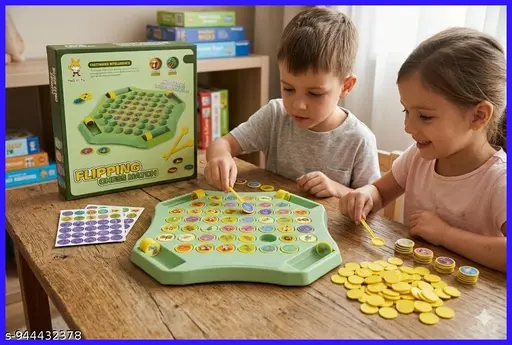
Lay a few cards face down, flip two, and try to remember where everything is. Almost every child plays some version of this game. It has been sold as Memory since the late 1950s, and it’s also known as Pairs, Pelmanism and Concentration. Its roots go back centuries, to a Japanese game of matching painted shells.
Parents often ask a fair question: is a memory match game actually good for kids, or is it just a way to pass the time?
The short answer: memory match is a good game for children from about age 3. It gives them practice holding pictures and locations in mind, taking turns, and sticking with a task until it’s finished. What it won’t do is make a child “smarter” in general. Research suggests it mostly makes kids better at the game itself and at similar tasks. That’s fine. A simple game that’s fun and exercises focus is worth having in the house.
Here’s what the game really does, how to match the difficulty to your child’s age, and how to get more out of every round.
The rules take ten seconds to explain. Shuffle the cards and lay them face down in a grid. On each turn, a player flips two cards. If they match, the player keeps them and goes again. If they don’t, both cards turn back over, and everyone tries to remember what they saw. Whoever collects the most pairs wins.
Playing alone works too. The goal is to clear the board in as few moves as possible, which makes it a good quiet activity.
Each turn asks a child to remember two things at once: what a picture was, and where it was. Psychologists call this visual-spatial working memory. A study of 80 children aged 4 to 6 found that how well they played the game was closely linked to this skill, even after accounting for age and other abilities.
In plain terms, the game exercises exactly the kind of short-term memory it appears to.
Good players don’t switch off when it’s not their turn. Every card an opponent flips is free information. Point this out to your child: “Watch, Nani just turned over the elephant. Where was it?” This turns the waiting time into practice at paying attention.
Memory match is a gentle introduction to rules, waiting and fair play. Rounds are short, so a loss stings less, and a rematch is always a few seconds away.
When you name the pictures out loud (“That’s a parrot! Can you find the other parrot?”), toddlers hear the same words again and again in a playful setting. This works best when an adult plays alongside them.
Plenty of apps and toy boxes promise that memory games will “boost brainpower.” The evidence is more modest.
Large reviews of memory-training programs have found no convincing sign that practising memory tasks leads to broad gains in intelligence or school performance. Children (and adults) mostly get better at the task they practise.
So treat memory match as what it is: a fun, low-pressure game that exercises attention and memory while it’s being played. It isn’t a shortcut to better grades, and you can ignore anyone who claims otherwise.
Here’s something many parents notice: young children are surprisingly good at this game.
Researchers have tested it. In one 1996 study, 5-year-olds made fewer location mistakes than both 10-year-olds and adults. A later study found that adults beat 6-year-olds but not 8-year-olds. One explanation is that adults bring in strategies that help in everyday life but don’t suit this particular game.
The idea that kids always win at memory is a myth. But this is one of the few games where a child and a grown-up can compete as near-equals. For a young child, beating a parent fairly is a real confidence boost, and you may not even need to let them win.
The most common mistake is starting with too many cards. A child who can’t find any pairs quickly loses interest. Use this table as a starting point:
| Age | Pairs to start with | Card style | Tip |
|---|---|---|---|
| 2–3 | 3–4 pairs, face up | Big, bold, single objects | Start by matching cards face up before hiding them |
| 3–4 | 4–6 pairs | Animals, fruits, everyday objects | Name every card as you flip it |
| 5–6 | 8–10 pairs | Themed sets | Ask them to say where a card was before flipping |
| 7–9 | 12–16 pairs | More detailed pictures | Try solo play and track the number of moves |
| 10+ | 18+ pairs | Similar-looking cards | Add a timer or a moves target |
A good rule: your child should find about half the pairs without help. Once they finish easily, add two more pairs.
Both are useful, in different ways.
Physical cards add hands-on play, and they suit family game time at a table. They’re also completely screen-free.
An online memory game needs no setup, never loses a card under the sofa, and often counts moves for you. That makes it easy to track improvement. It’s handy for a quick round in a waiting room or on a short break.
If you go digital, keep the World Health Organization’s advice in mind: no more than one hour of screen time a day for children under 5, and none for babies under 1. A short round of a memory game fits easily within that, especially if you sit with younger children and talk through the game together.
For a free option, Online Timepass Games has a browser-based Memory Match game. It has easy-to-hard levels and an automatic moves counter, and it needs no download or sign-up.
Memory match has lasted for generations because it’s simple, fair and fun at almost any age. It won’t turn your child into a genius. But it does give them a few happy minutes of focused play, practice in remembering and paying attention, and the rare chance to beat a grown-up without any help. That’s a good deal for a game that takes ten seconds to learn.
7. FAQs
What age can kids start playing memory match?
Most children can play a simple version from about age 3, starting with 4–6 pairs of large, clear pictures. Two-year-olds can start by matching cards face up.
Does a memory match game improve memory?
It exercises short-term visual and spatial memory while the child plays, and children get better at the game with practice. Research hasn’t shown that it improves memory or intelligence more broadly.
How many cards should a 4-year-old use?
Start with 4–6 pairs (8–12 cards). If your child finds most pairs easily, add two more pairs at a time.
Is an online memory game OK for young children?
Yes, in short sessions. The WHO advises no more than one hour of screen time a day for children under 5, so keep rounds brief, and play together when possible.
Why do kids sometimes beat adults at memory?
Studies suggest young children are surprisingly competitive at this game, partly because adults rely on strategies that don’t suit it. Adults don’t always lose, though: in one study, they beat 6-year-olds but not 8-year-olds.

This post has been authored and published by one of our premium contributors, who are experts in their fields. They bring high-quality, well-researched content that adds significant value to our platform.










Home Guide provides trusted home improvement tips, DIY ideas, maintenance guides, and interior design inspiration to help you create a smarter, safer, and more beautiful home.